Black
Black Tortoise
 Gunmetal
 Brown
Brown Silver
 Purple











Your prescription explained
Your prescription contains information about your eyes that is required to make the right lenses for you. This page should help you ensure that you've got everything you need before placing an order with us.
Commonly asked prescription questions
You can find some suggestions for where to get a good deal on your eye test here.
The optician is legally obliged to provide you with a copy of your prescription after your eye test. If they don’t give you this, make sure you ask them.
Your prescription must be no older than two years. Your recommended intervals between eye tests vary depending on your age and health – find out more about eye tests in this article.
After following steps to select your lenses and package, you’ll be given three options for sharing your prescription with us: "send prescription later", "enter new prescription", or "use saved prescription". If you’ve shopped with us before and your prescription is up to date, select "use saved prescription".
If you’re new to Glasses Direct (or have a new prescription) and have your prescription on hand, then select "enter new prescription". If you’re in need of a new prescription, select "send prescription later". This option allows you to send your prescription via photo, email, phone or post after you’ve placed your order.
Please note that we are unable to fulfil some prescriptions. Orders for very strong prescriptions are excluded, such as when the combined SPH and CYL is greater than +/-9.75, when the CYL is over +/-4.00, if there is more than a 5.00D difference between each eye or if the prism correction is over 4.00 in any direction. Orders for prescriptions with a combined SPH and CYL of more than +/- 8.00 can currently also only be placed over the phone.
The first thing to check is the values of the prescription your optician provided with the specification that we have supplied. This will be saved on your online account. If the values don’t match, please contact us right away to let us know, and return the glasses to us along with a copy of the original prescription.
If they both match, the prescription still might be correct. Most new prescriptions take a little while to get used to, especially if there has been quite a change since your last one. It’s best to persevere, but if the new glasses are giving you eye strain and you haven’t settled into them after wearing them for 2-3 days, please let us know and one of our opticians will advise you on what to do. It will be helpful to know your previous prescription if you have it, so we can compare.
A weak prescription is one where the Sphere (SPH) value is less than +/- 1.50 and the Cylinder (CYL) is less than +/-0.75. A strong prescription is one where the SPH is over +/-5.00 or the CYL is over +/-2.00.
People whose prescriptions have a SPH between +/- 1.50 to +/- 5.00 and CYL values between +/-1.00 to +/-2.00 might think their prescriptions are really high, but from an optician’s point of view, they’re considered moderate.
Below is a list of the numbers and letters that you can find on a prescription and what they mean:
‘+’ or ‘-‘
The ‘+’ symbol indicates long-sightedness and the ‘-‘ symbol represents short-sightedness.
SPH or Spherical number
This shows how strong the correction needs to be.
CYL or Cylinder number
This shows how much astigmatism you have.
AXIS
This shows the position of the cylinder. It will be between 1 and 180.
PD or Pupillary distance
This is the distance between your eyes, measured between your pupil centre points.
ADD
This will indicate if you need a prescription for reading.
PRISM
This shows if you have a muscle imbalance in your eye.
BASE
This shows the direction of the prism in your lens.
You can read more about what all this means for your eyes here.
Common layouts of prescriptions
Here are some common prescription layouts that you might see. For each version, we have included how it should look when entering it on our website.

How it should look on our website:


Here the signs have been written ABOVE the numbers - they are still just standard +/- signs.
It can be hard to tell where one number ends and the next one begins. It helps to know that sphere and cylinder will always be in the format (x)x.yy, with x being a number from 0 to 10 and yy being either 00, 25, 50 or 75. The axis is always a number between 1 and 180.
How it should look on our website:
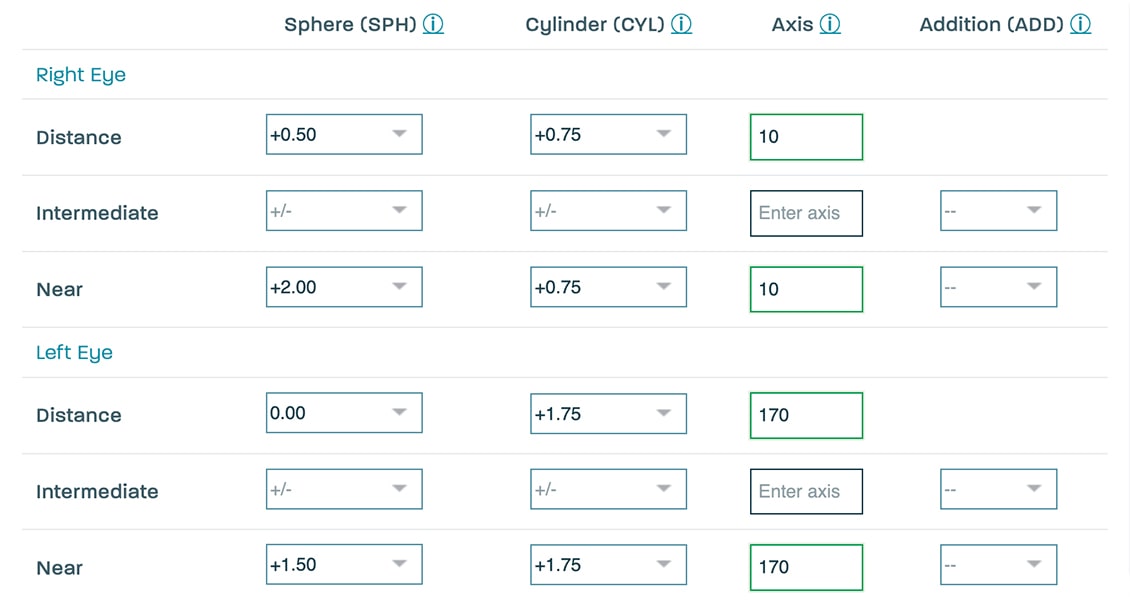
You can click “My prescription doesn't look like this” to expand the menu.
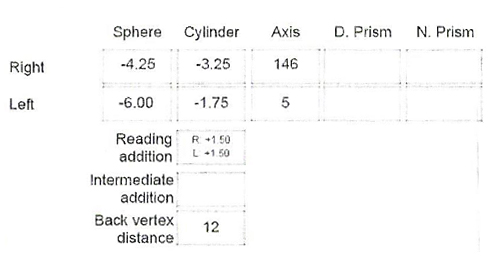
How it should look on our website:

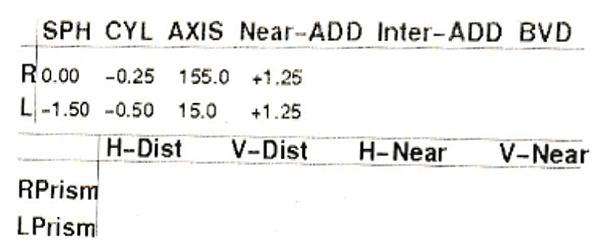
How it should look on our website:

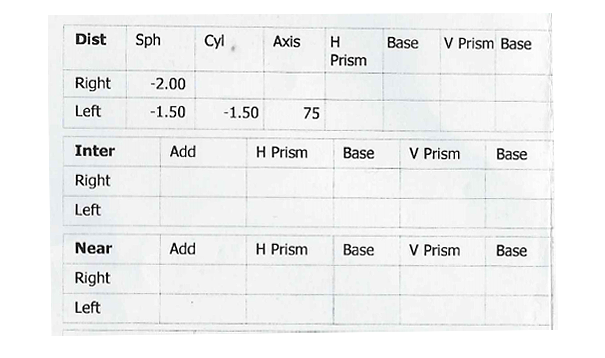
How it should look on our website:

Less common prescription figures
Below are some examples of more unusual cases you may encounter, along with instructions for what to do if these ever apply to you.
If you need a prism for one or both eyes, it will look similar to this:
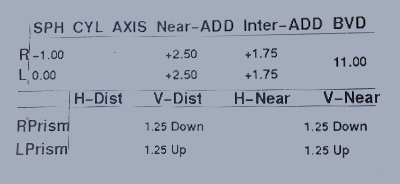
We can provide lenses with a prism correction, but you’ll need to contact us to discuss this.
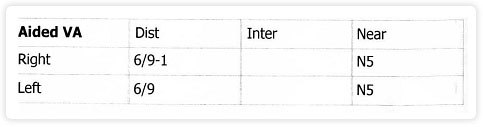
Sometimes figures like this appear on your prescription. These are not needed to make your lenses:
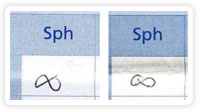
Some prescriptions have this figure, which looks like a sideways 8. This means ‘infinity’. And you should select ‘infinity’ from the list:
This prescription has some figures scrawled underneath - these are additions for both intermediate and near distances. Even though it’s a single figure, it applies to both eyes:
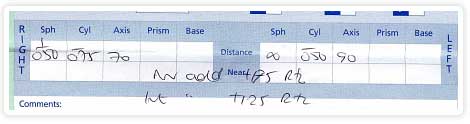
To enter this, you’ll need to use the “My prescription doesn't look like this” link to show the more advanced prescription area.
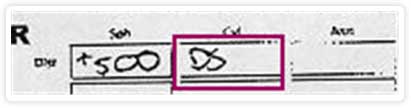
Sometimes opticians write ‘DS’ in the CYL column. This simply means there is no astigmatism, and you can enter either nothing (leave the field blank) or select the phrase DS in the drop-down: