- Sunglasses
- Lenses
- Brands
-
Home Trial
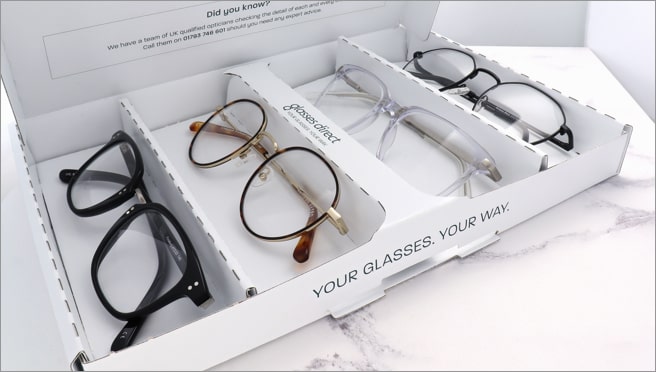

Or select a ready-made Free Home Trial Pack
- Offers
- Help & FAQ
Or select a ready-made Free Home Trial Pack
At Glasses Direct we give you the choice of different lens options and coatings, perfectly designed to meet your vision needs. Take a look at some common lens questions and our tips to find the perfect solution for you.
A: This could be down to either your glasses not fitting very well, or the lenses in your glasses causing the glasses to weigh heavily on your nose. For help on how to make simple adjustments to your glasses please see our guide. The thickness of your lenses depends on: the size and material of the frames and lenses, the strength of your prescription, and the position of your eyes within the frames. There are a few options to reduce the lens thickness, and a combination of two or more might be the best course of action.
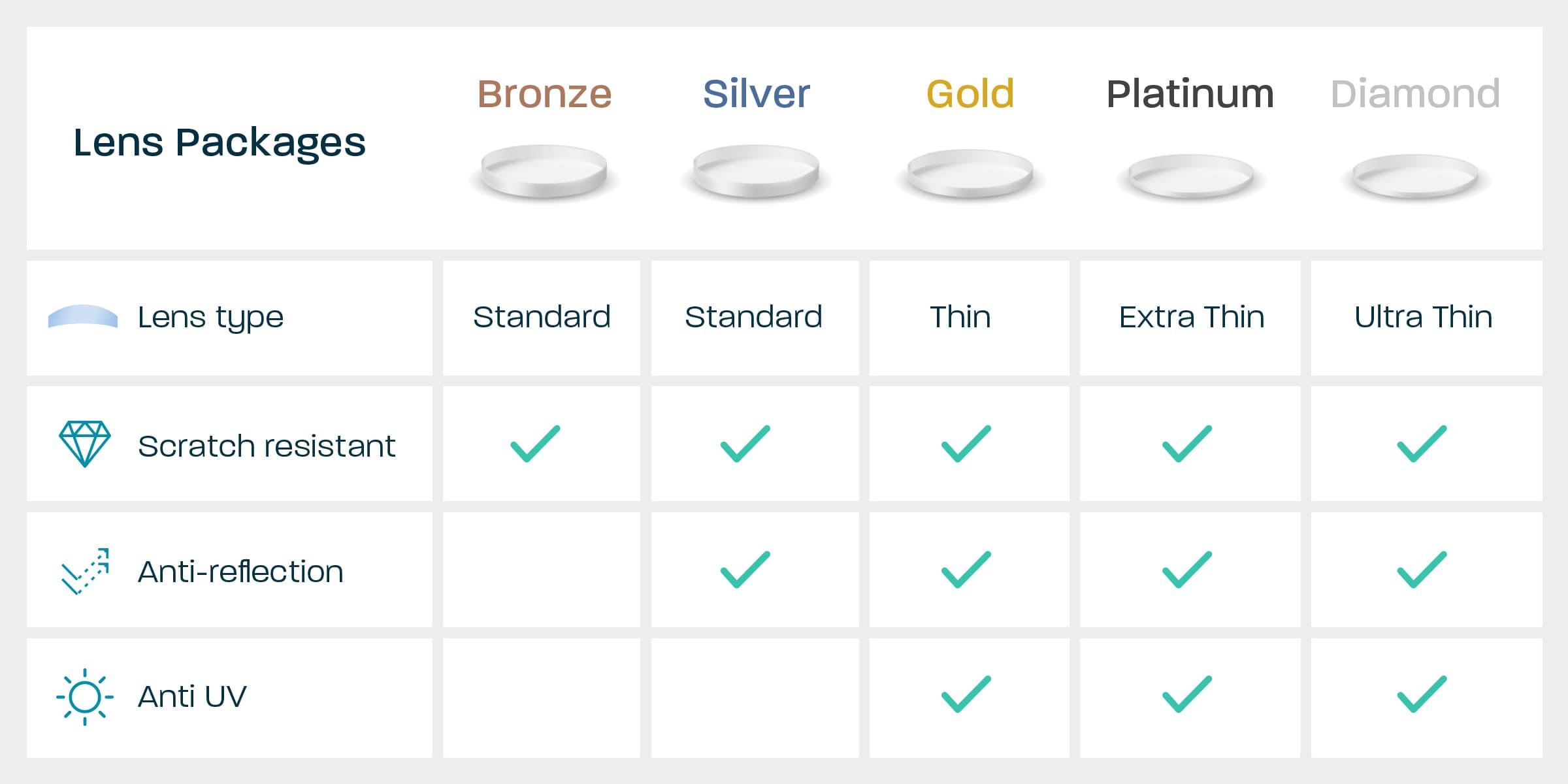
To reduce the weight of your lenses, you can choose a smaller frame - which will reduce the amount of substance of your lenses - and/or opt for thinner, lighter lenses. Our thinner lenses can reduce the thickness and weight of your lenses by 20% for the Gold Package, 33% for the Platinum Package, and up to 42% for the Diamond Package lenses. Please note, the Diamond Package is only available via phone order. For more help and advice please see our ‘Best lenses for your prescription’ guide, or contact one of our expert opticians.
A: There are three main ways this can be limited. Firstly, the cheapest way is to choose a frame with a smaller lens size. Of course this will depend on the size of your head, and we wouldn’t advise you to choose a frame that was smaller than you need.
Secondly you should consider selecting a frame with thicker rims to hide the edge thickness. Plastic rimmed frames are very fashionable now and are a lot thicker than metal ones. Lastly, if you choose our extra thin Platinum Package lenses you could reduce the edge thickness by 33%. Or by 42% if you choose the Diamond package (only available via phone orders on 01793 746555). If you pick thinner lenses, choose a frame with a smaller lens size or with thicker rims, your lenses could be completely contained within the rim of the frames.
A: The first thing to consider is whether or not your prescription is up to date. If it’s not, then have a new sight test and mention your difficulty to your optician. You may need a special prescription for the computer.
If your prescription is up to date and you’re using the correct glasses for the computer, then we’d recommend you select our BlueReflect™ coating. This will help protect your eyes against High Energy Visible blue light, which is given off by many modern mobile devices. It will improve contrast and visual comfort, while reducing glare.

A: Uncoated spectacle lenses transmit only about 90% of the available light, with the rest lost through reflections at the lens surface.
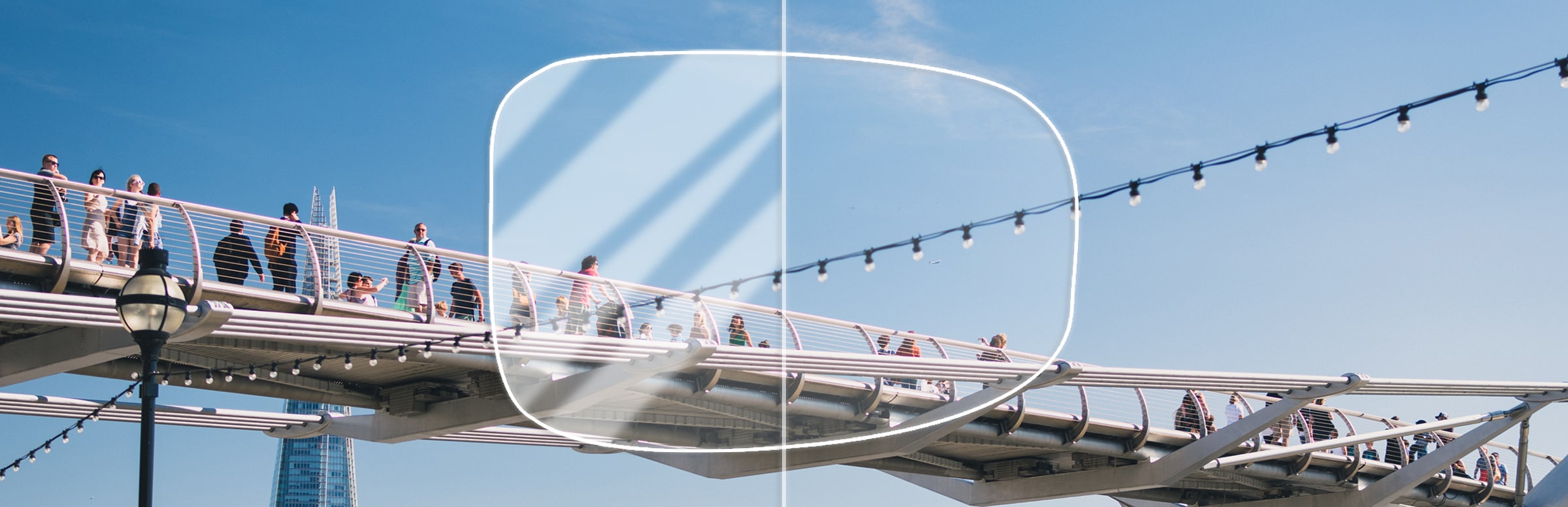
In level lighting conditions this isn’t very often a problem. However, the enhanced contrast between dark night-time and the intense brightness of car headlights means this can be problematic, and explains why headlights dazzle your eyes. Luckily you can fix this by choosing an anti-reflection coating, which reduces reflections to less than 1%. It’s standard on our Silver, Gold, Platinum and Diamond lens packages. The Diamond package is only available via phone orders on 01793 746555.
A: Selecting a lens package with an anti-reflection coating will greatly reduce this. Uncoated lenses lose around 10% of the available light through reflections, so selecting an anti-reflection coating will reduce lost reflections to less than 1%, making your lenses much clearer - almost like you don’t have lenses in them at all. It’s standard on our Silver, Gold, Platinum and Diamond lens packages. The Diamond package is only available via phone orders on 01793 746555.
A: As you get older your eyes will gradually lose their ability to see closer objects. If you wear glasses for long distance all the time there will come a time, usually around the age of 40, when the glasses won’t focus properly for both long and close distances. Rather than having a separate pair for reading, why not consider getting varifocals instead?
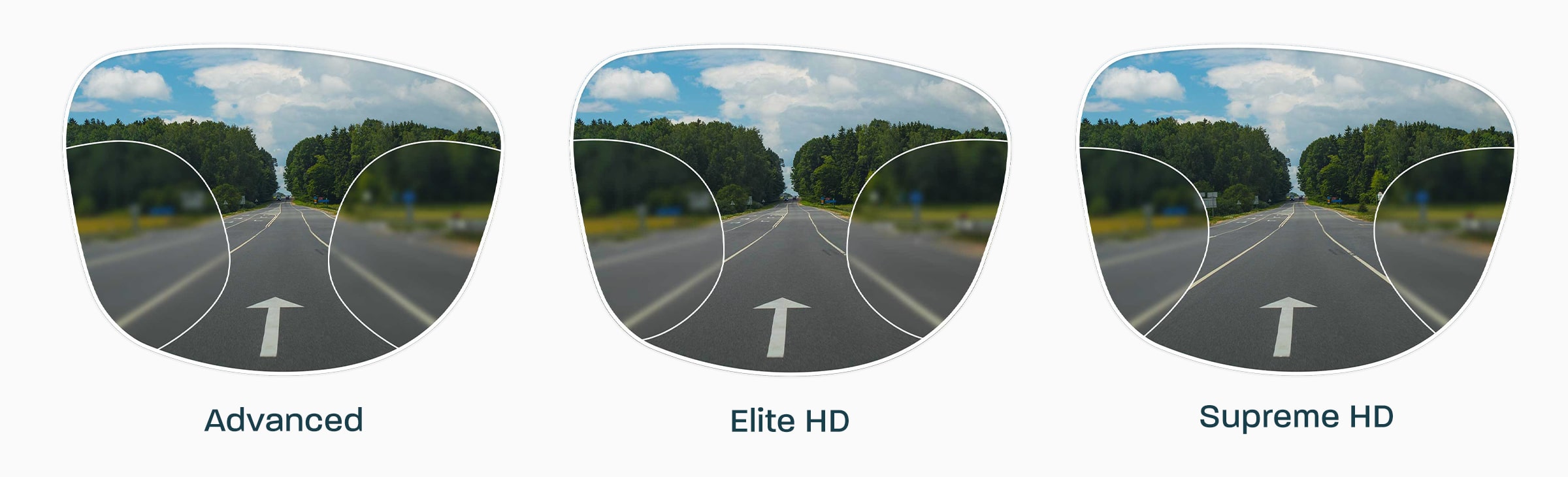
With varifocals you won’t have to carry two pairs of glasses around with you all the time. The varifocals increase in strength from your long distance, which is at the top of the lens, to your reading, at the bottom. There will be a point on the lens that will correspond to all the distances you want to see. Our Advanced varifocal lenses are a modern ‘Freeform’ lens design which gives a wider field of vision than standard lenses.
Our top of the range Elite lenses feature multi-aspheric, Freeform lens technology including a special aberration filter that reduces distortion at the edge of the lens. Elite HD offers a 30% improvement in field of vision compared to a conventional lens, and is our recommended lens for all wearers. To find out more please see our guide to varifocal lenses.
A: Head movement is needed for all varifocal lenses. However, there are lenses that will give you enhanced field of vision at all distances, which will greatly improve visual comfort. Our Elite HD lenses utilise a multi-aspheric, Freeform lens technology including a special aberration filter to greatly reduce distortion at the edge of the lens. They have around 30% greater field of view than our Advanced lenses, which themselves have a wide field of vision.
A: Whilst modern varifocal lenses give a very good field of vision for mid-distances, some people who use a computer for most of the day, or who need to examine detailed drawings or documents over a wide area may benefit from an ‘occupational varifocal’.
Like a regular varifocal there is no dividing line, and they change gradually from the top to the bottom, but don’t offer much longer-distance vision. What they do offer is a significantly wider field of vision for middle and near distances. If you’d like to find out more about these it’s best to speak to one of our opticians who can take you through all the varifocal lens options.
A: It’s very common to be sensitive to strong sunlight, but it’s simple to ease the symptoms with a variety of tint options. The simplest and cheapest tint is a fixed dark tint. These block out about 85% of the intensity from the sun and come in dark brown, green, or grey. The depth of tint doesn’t change depending on the lighting conditions, so if the brightness of the sun changes you’ll need to change into your clear glasses. We know this isn’t convenient for many people so we recommend trying Transitions® lenses.
These lenses adjust their darkness depending on how bright the sun is. When the sun is weak or you’re indoors, they’re virtually clear, however, in strong sunlight they can darken to block out 75% of the sun’s glare. For drivers, we’d recommend selecting Transitions® Drivewear lenses that also work in the car. Unlike standard Transitions®, though they aren’t suitable for night time driving. If you’re very sensitive to bright light both inside and outdoors we’d recommend Transitions® XTRActive® that go extra dark.
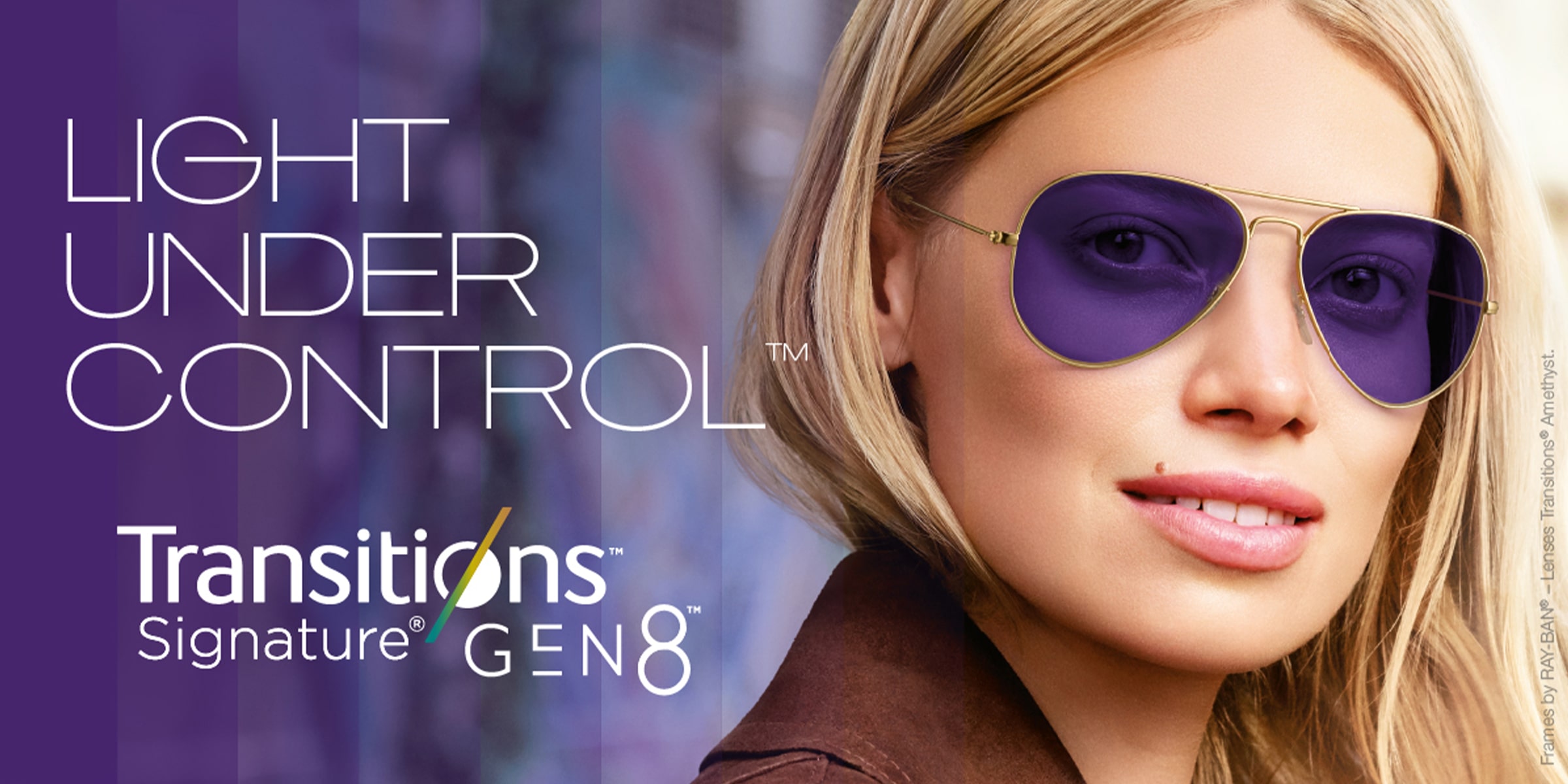
A: Dark tinted glasses are great when the sun is always the same intensity, but not so good when the sun goes in, or when you go indoors. Choosing Transitions® lenses is the most convenient way of ensuring your lenses are always the correct level of tint for the light conditions.
Indoors, or when the sun is weak, Transitions® lenses are almost perfectly clear. They’re perfectly safe to drive at night with. When the sun gets stronger, special photo-sensitive cells within the lens are activated, making the lens go darker, or clearer if the sun goes in, or if you’re indoors.
They’re quicker to darken than they are to fade, and if you do a lot of driving we’d recommend you choose Transitions® Drivewear lenses that work in the car. Please note they aren’t suitable for night driving. For very light sensitive people Transitions® XTRActive® are a very good choice.
A: Transitions® lenses are just the ticket for outdoor use, but they don’t react in a car, unless you have a convertible. As such, Transitions® specially developed their Drivewear lens to solve this problem.
In low light they’re green/yellow for high contrast, and turn copper in bright light, darkening to dark red-brown in the brightest light. As an added bonus they’re also polarised to ward off the unwanted glare from wet roads. Please note, Drivewear lenses aren’t suitable for night driving.
For those who are really light-sensitive, Transitions® offer their XTRActive® lens for the very brightest conditions both indoors and outdoors. They also work in the car.
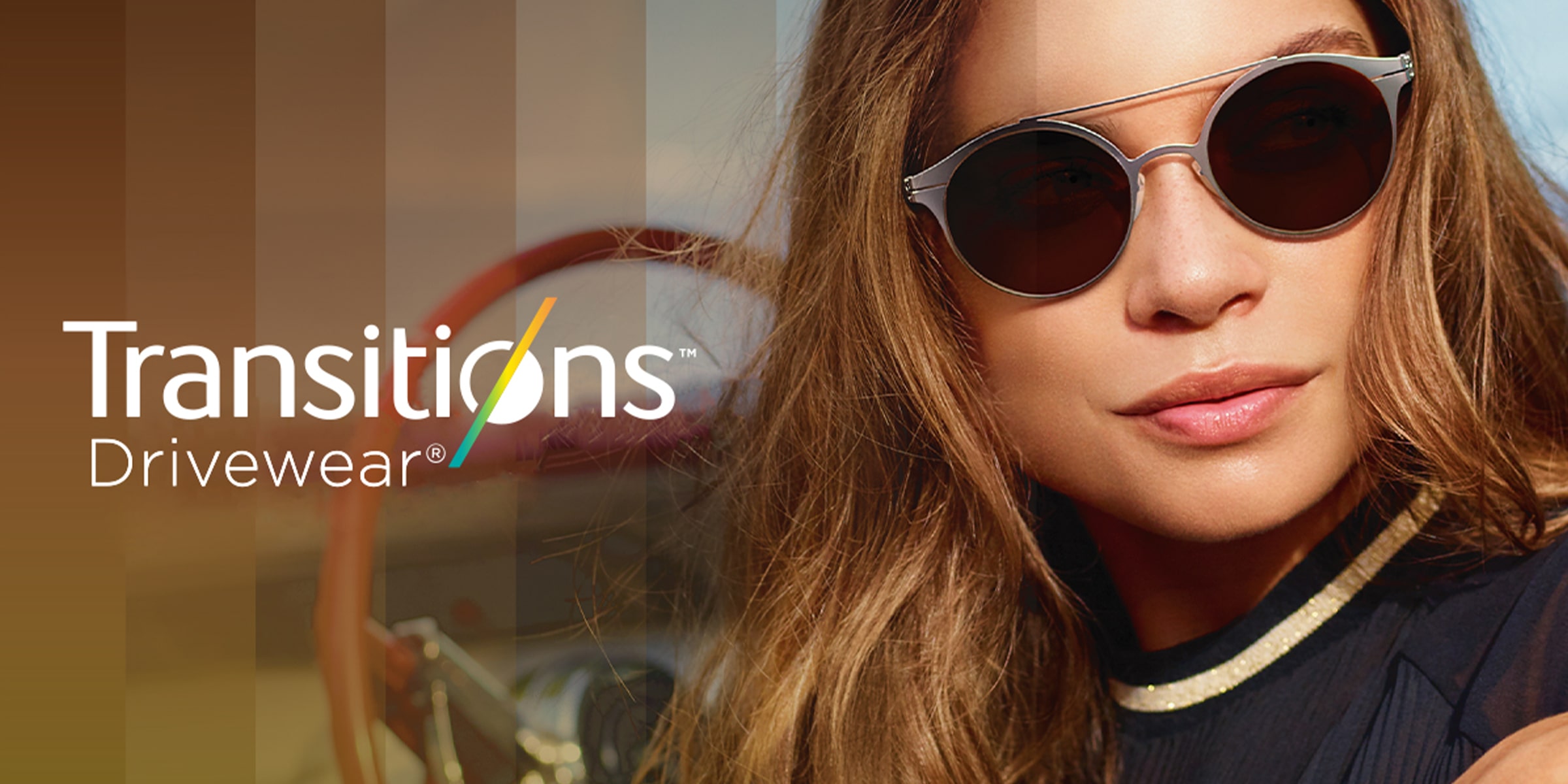
A: This is a very common complaint, and the glare caused can be very problematic. The best way to combat this is by having a pair of polarised tinted glasses that will cut out the horizontal reflected glare.
We have fixed, dark tinted polarised lenses with either a brown, or grey coloured tint that will be ideal when the sun is strong, or you can choose Transitions Drivewear lenses. These combine polarisation with the ability to change according to the light levels, and even darken in the car. Because they’re classed as sunglasses, they shouldn’t be worn to drive at night.
A: Of course! Having perfect eyesight shouldn’t stop you from having stylish glasses. You can add a non-prescription dark or Transitions® tint to any of our frames.
As basic lenses are included free with the frames, all you’ll pay for is the tint. Just be sure to follow these steps to make it clear for our team that you're looking for non-prescription sunglasses.
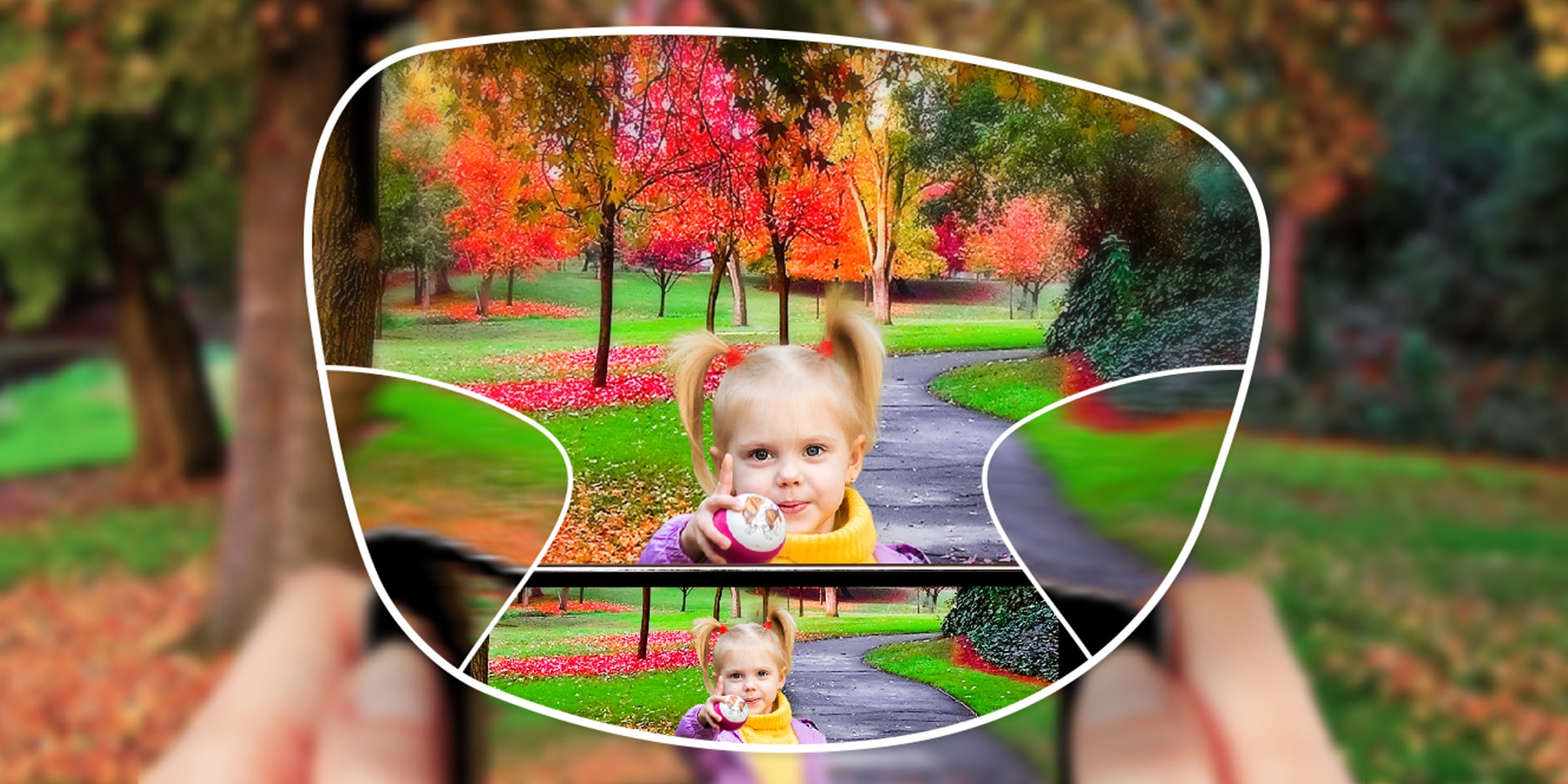
KODAK Lenses are available either as clear single vision KODAK Clean&CleAR Lenses, KODAK UVBlue Lenses, or varifocal KODAK Easy2 Max Lenses.
The KODAK Easy2 Max Lens is our premium varifocal option which offers superior performance at all distances by reducing peripheral distortion. This improves clarity and makes the transition over to varifocals far easier for new varifocal wearers. However, because they offer unrivalled clarity and comfort, existing varifocal wearers are recommended too.
Our KODAK Clean&CleAR Lenses offer improved clarity, with an anti-reflection coating reducing glare while driving at night and improving comfort while using electronic devices. A water-repellent coating can repel cosmetics too, while an anti-static coating repels dust and dirt. KODAK Clean&CleAR Lenses block harmful UV rays and are easy-cleaning, available in a range of lens thicknesses suitable for most prescriptions. The KODAK UVBlue Lens blocks UV light and filters out harmful blue light. It provides greater contrast and increased visual comfort.





 Black
Black Tortoise
 Gunmetal
 Brown
Brown Silver
 Purple