








Transitions® lenses vs sunglasses: are they worth it?
18 May 2026

In short: Transitions® lenses are ideal for everyday convenience, adapting to changing light conditions while maintaining clear vision. Sunglasses — especially with polarised lenses — provide stronger glare reduction and better performance in bright sunlight.
👉 Best option: Use both for complete UV protection, better eye care, and all-day comfort in every light condition.

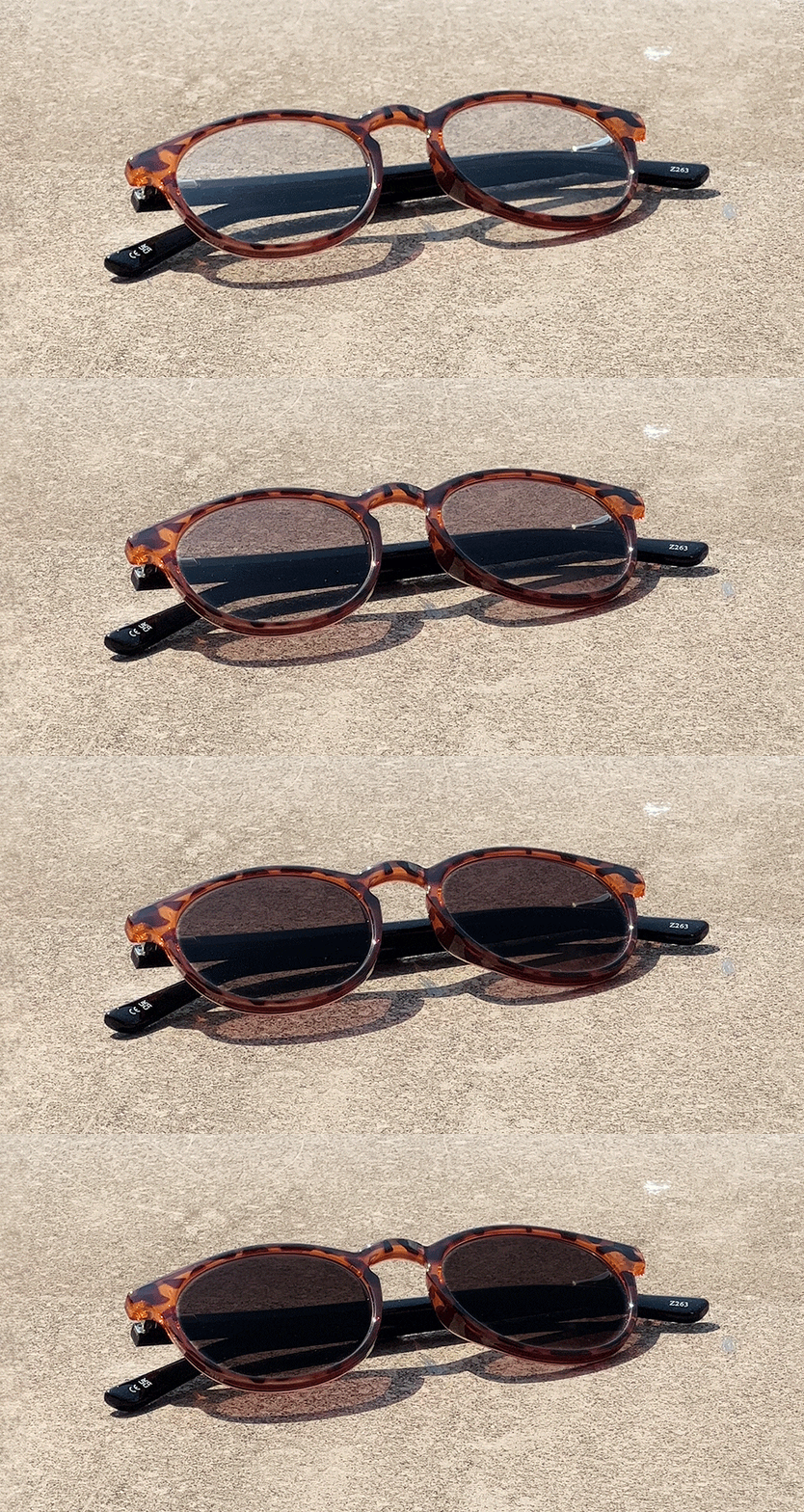
Transitions® lenses (photochromic lenses) automatically adjust from clear to tinted in response to UV light, while sunglasses use fixed tinted lenses to provide constant protection from bright sunlight.
Both support clear vision and UV protection, but they are designed for different environments.
👉 Best approach: Transitions® lenses are ideal for everyday wear, while prescription sunglasses are best for driving, holidays, and high-glare conditions.

Transitions® lenses are light-adaptive photochromic lenses that darken when exposed to UV light and return to clear indoors. They are built into your prescription glasses, so you don’t need to switch between multiple pairs.
These transition lenses react automatically to ultraviolet (UV) rays, helping maintain clear vision, visual comfort, and eye protection throughout the day.
Advanced options include:
👉 Also known as photochromic glasses or transition glasses, they are designed for convenience, clear vision, and all-day wear.

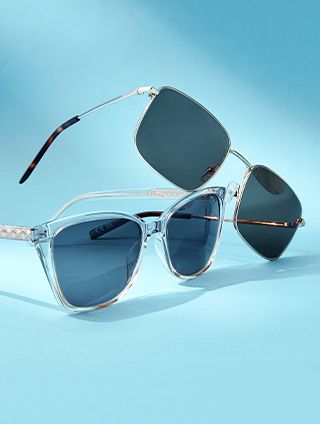
Sunglasses use fixed tinted lenses to reduce brightness and provide consistent UV protection. They are essential for maintaining clear vision in bright sunlight and also protecting your eyes from harmful UV rays.
Many sunglasses feature polarised lenses, which significantly reduce glare from reflective surfaces such as roads, water, and snow.
👉 A dedicated pair of prescription sunglasses with polarised lenses offers the highest level of comfort, clarity, and protection.
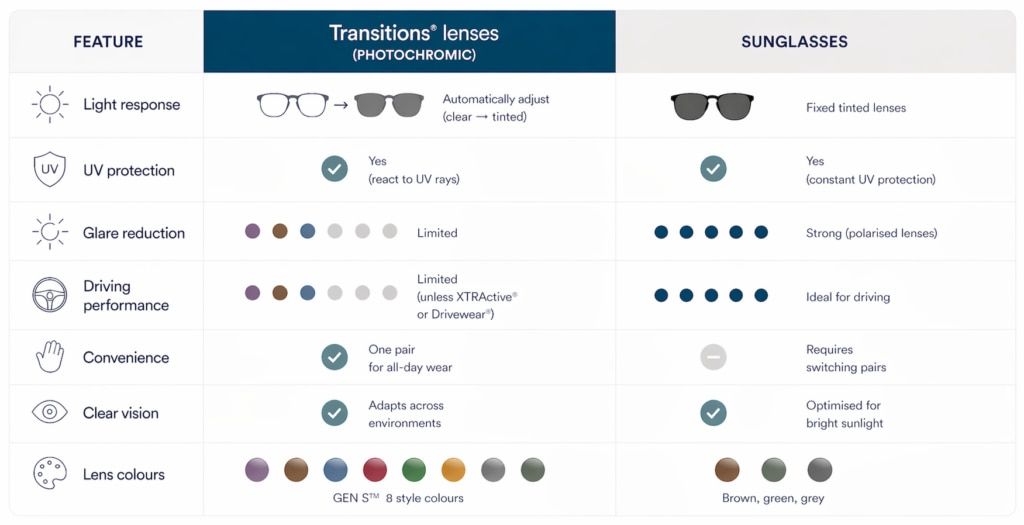
👉 Quick summary:
Transitions® lenses are worth it if you:
They reduce the hassle of carrying multiple pairs while supporting clear vision and every day eye health.

Sunglasses are the better option if you:
They provide more consistent performance in intense light where Transitions® lenses can be less effective.

Transitions® lenses react to UV light, but a car windshield blocks most UV rays. This means they do not darken fully while driving — unless you choose Transitions® XTRActive® lenses or Drivewear® lenses.
They also don’t match the glare reduction of polarised sunglasses lenses, which are designed specifically for high-glare environments.
👉 For this reason, many people use:

Both Transitions® lenses and sunglasses offer clear benefits depending on how and where you wear your glasses. This quick comparison highlights how each option performs in everyday situations, helping you choose the right fit for your lifestyle.
✔️ One pair of glasses for all-day use
✔️ Automatic adjustment to light conditions
✔️ Clear lenses indoors, tinted lenses outdoors
✔️ Support clear vision across changing environments
✔️ Include blue light filtering
❌ Less effective behind a car windshield (unless upgraded lenses)
❌ Limited glare reduction compared to polarised lenses
❌ Slower activation in colder temperatures
✔️ Strong UV protection from sunlight
✔️ Superior glare reduction with polarised lenses
✔️ Ideal for driving and bright environments
✔️ Provide consistent clear vision in strong sunlight
❌ Require a second pair alongside prescription glasses
❌ Not suitable for indoor use

Yes — Transitions® lenses (photochromic lenses) are worth it if you want convenience, fewer pairs of glasses, and reliable clear vision throughout the day.
Advanced options like Transitions® XTRActive® lenses and Drivewear® lenses make them even more versatile.
However, they do not fully replace sunglasses.
👉Best approach: Use Transitions® Gen S™ lenses for everyday wear, and keep a pair of prescription sunglasses with polarised lenses for driving, holidays, and bright sunlight. Transitions® XTRActive® and Drivewear® lenses are also well suited for driving conditions.

👉 Many people find combining both offers better long-term value for eye health, UV protection, and clear vision.
Yes — Transitions® lenses are a convenient solution for everyday vision correction, adapting to light and reducing the need for multiple pairs.
They respond to UV light, so they stay clear indoors and darken outdoors. For driving, XTRActive® and Drivewear® lenses offer improved performance.
Yes — especially for driving and high-glare environments where polarised lenses perform very well.
Yes, all Transitions® lenses filter blue light from screens and sunlight to help reduce eye strain.
For glare reduction — yes. Polarised lenses are better for driving and reflective environments.
Yes — they provide UV protection, helping reduce the risk of long-term eye conditions such as cataracts.
Transitions® lenses can be combined with varifocal prescription lenses, allowing you to see clearly at multiple distances without needing separate reading glasses.
However, Transitions® lenses are not available with bifocal lenses, so they cannot replace all multifocal options.