




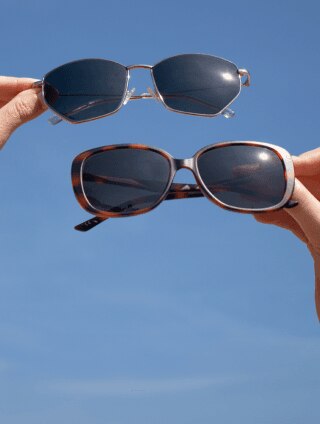
Aviator sunglasses for women: styles, face shapes and how to choose
10 May 2024

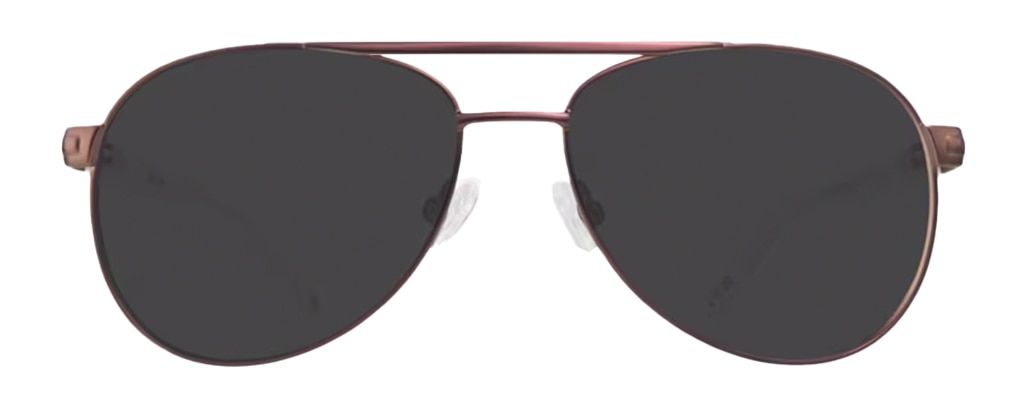
In a nutshell: Aviator sunglasses for women are pilot-style frames with large teardrop lenses and a thin metal bar across the brow. The first pair was made in 1936 for US Army Air Corps pilots. Today they suit most face shapes, come in metal and acetate, and work with prescription, polarised and 100% UV-protective lenses.
Who they suit: oval, square, heart and diamond faces suit the classic teardrop. Round faces suit squarer styles.
What to look for: 100% UV protection, lenses that fully cover your eyes and adjustable nose pads.
How to wear them: as prescription sunglasses, with polarised lenses for water and roads, or with light-adaptive photochromic lenses for changing light.

Yes. Aviators started as part of the kit for military pilots, but women have worn them for decades. Most aviator styles are unisex, so the right pair comes down to size and lens shape, not gender.
A metal aviator works with a summer dress, a blazer or formal wear. Plastic or acetate aviators are ideal for festivals, beachwear and other casual looks. That's why you'll see them everywhere from the school run to the front row.
When people search for aviator sunglasses, they're usually after three things: a frame scaled to their face, a lightweight build and a lens colour that goes with their wardrobe. All three are covered below.

In 1936, Bausch & Lomb made a prototype called "Anti-Glare" for pilots in the US Army Air Corps. It had a plastic frame and green lenses designed to cut glare at high altitude without blurring vision. The deep teardrop shape kept pilots' eyes covered as they glanced down at their instrument panels.
The frame was remodelled from metal, and in 1937 Bausch & Lomb patented the design and sold it to the public as the Ray-Ban® Aviator. The Ray-Ban® name explains the job of the lenses, designed to "ban" the sun's "rays".
Ray-Ban® then designed versions for shooting and the outdoors. In 1957, it launched the Caravan, an aviator with squarer lenses. That shape is what most people now call a navigator style.

From the 1960s to the 1980s, women made the aviator their own. Gloria Steinem, Stevie Nicks and Bianca Jagger all wore them, and the look came to signal confidence with a hint of rebellion.
The style hasn't gone away. Jennifer Lawrence, Angelina Jolie, Kendall Jenner and Jennifer Lopez are regularly photographed in aviators, and designers keep reworking the shape in new colours and materials.
Aviators suit most face shapes. The lens shape makes the biggest difference. Use the table below as a starting point, then check our sunglasses face shape guide.
| Face shape | Aviator style to try | Why it works |
|---|---|---|
| Oval | Classic teardrop | Balanced proportions suit most lens shapes |
| Square | Classic teardrop | The curved lens softens a strong jawline |
| Heart | Classic teardrop in light metal | The deeper lower curve balances a narrower chin |
| Diamond | Classic teardrop | The lens follows the line of your cheekbones |
| Round | Square or navigator style | Straight lines add definition |
| Oblong | Oversized aviator | A deeper lens breaks up the length of the face |
Oversized aviators give more coverage and make more of a statement. They work best on longer or wider faces. On a smaller face, check the lens width on the product page: the classic Ray-Ban® Aviator comes in several sizes, commonly 55, 58 and 60 mm, so you can get the look without the frame swamping you.
Aviators were built to stop pilots from squinting into bright sun, and they still do that job well. Here's what they offer day-to-day.
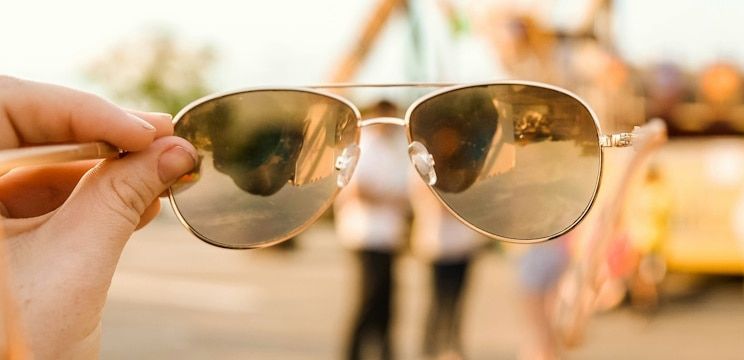


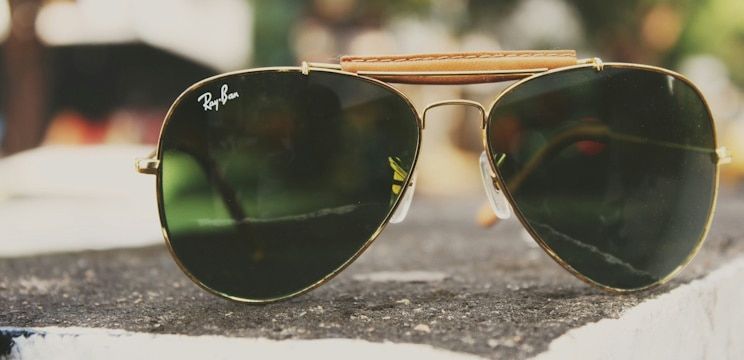
The best aviator sunglasses for women should suit your face shape, provide 100% UV protection and suit your lifestyle. At Glasses Direct, you'll find classic metal pilots, acetate styles and designer styles, and with 2-for-1 sunglasses from £49, you can take home two pairs for one great price.

Ray-Ban® and Persol® are the names most people think of first. For Ray-Ban® ladies' aviator sunglasses, start with the original Aviator in gold or silver metal with green or brown lenses. Want something bolder? The Ray-Ban® Aviator Max has a thicker metal frame, a double bridge and an XL fit. Persol® adds its flexible Meflecto temples, which ease pressure behind the ears. Browse our Premium Designer range.
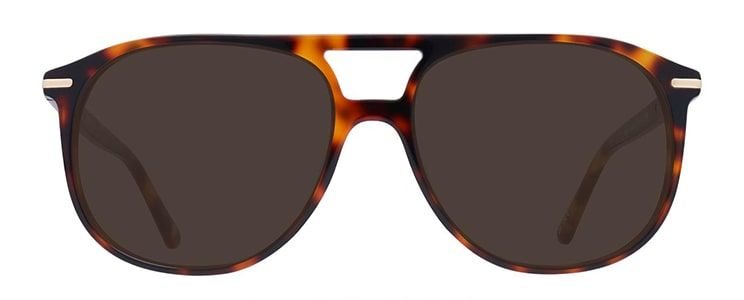
If classic gold feels too familiar, try a clear acetate frame or a coloured lens. Gradient tints — darker at the top and fading to clear — work well for city days. Transitions® GEN S™ are a stylish, versatile option for busy lifestyles and come in a variety of trendy style colours like sapphire and ruby.
For active days, sports aviators use lighter materials and a closer fit, so they stay on while you run, cycle or play golf. They go with gym kit too, if you'd rather just look the part. Take a look at Harrington Sport and Oakley.
Navigators swap the teardrop for a squarer lens. They're more compact and suit round faces especially well. Choose an acetate frame for a modern look, or a metal frame for something closer to the original.
For a 70s feel, go for a tortoiseshell acetate frame. For the 80s, a classic Ray-Ban® Aviator in gold metal does the job. Not sure which pair is you? Order a few with our free Home Trial and try them on at home before you decide.
Are aviator sunglasses unisex?** Most are. The shape was designed for pilots of any gender, so choose by size and lens shape rather than a men's or women's label.
Oval, square, heart and diamond faces suit the classic teardrop. Round faces suit squarer navigator styles, and longer faces suit oversized aviators.
Ray-Ban® aviators are unisex and come in several lens widths. Women with smaller faces often choose the smallest size of the original Aviator.
They can be, as long as the frame isn't wider than your face. Check the lens width and frame width on the product page before you buy.
Yes. You can add your prescription to most of our pilot frames, with tinted, polarised or light-adaptive lenses.
Yes, in daylight. Polarised lenses cut glare from wet roads and low sun. Don't wear tinted lenses for driving at night.
Aviators have curved teardrop lenses. Navigators have squarer lenses and a more compact shape.