








When were glasses invented? A complete history of eyewear
18 December 2025

Exactly when eyeglasses were invented is still unclear. Historians continue to debate who invented glasses and how these essential visual aids first came into use. What we do know is that the very first type of glasses appeared in Italy — most likely in Venice during the 13th Century, when glassmaking flourished. These early spectacles marked a turning point for people with vision problems. They paved the way for prescription glasses, contact lenses, and even the blue light lenses we use today.
Since their creation, prescription glasses have evolved from simple magnifying tools into fashionable accessories. Millions of people worldwide now rely on them not just as an aid to correct vision, but as a reflection of their personal style. Let’s explore the fascinating milestones that shaped the history of glasses — from early experiments to the high-tech eyewear of the modern era.
Many sources agree that it’s difficult to pinpoint exactly who invented glasses. Their development spans centuries and involves numerous contributors. The question of who invented glasses often highlights how different cultures experimented with optics long before modern eyewear existed.
The origins of visual aids stretch back to ancient times. The Roman Emperor Nero reportedly watched gladiator games through a polished emerald to improve his vision. This was one of the earliest recorded examples of magnifying glasses being used to help with vision problems.
The Romans were also among the first to observe that glass could enhance sight. These discoveries laid the foundation for later optical innovations, moving us closer to the invention of glasses as we recognise them today.
In the 9th Century, Arab scholar Abbas ibn Firnas developed “reading stones” — small domes of polished glass used to magnify text. These were the first true visual aids designed to assist with reading , particularly for people with presbyopia (age-related farsightedness).
By the 12th Century, similar magnifiers were spreading across Europe. Scholars and monks used these magnifiers to read illuminated manuscripts, representing a crucial step toward the invention of glasses and the development of corrective lenses.

Most historians agree that the first wearable eyeglasses appeared in Venice, Italy, during the 13th Century — the heart of the Italian glassmaking trade. These early types of glasses were made from crystal or glass, and the wearer would typically have to hold them up to their face by hand.
Used mainly by monks and scholars, these spectacles aided reading and writing, and quickly became symbols of wisdom and social status. Although simple compared to today’s plastic lenses, they marked the true beginning of the invention of glasses and the history of modern eyewear.
As vision correction became more common, new styles of glasses emerged during the 14th Century. The French introduced pince-nez (meaning “pinch-nose”) glasses. These gripped the nose without side arms — not always comfortably, as the wearer needed to stay very still to keep them in place! Around the same time, scissor glasses became popular among the upper classes. These could be folded neatly into a pocket for easy storage.
Despite their reputation for being uncomfortable, scissor glasses experienced a resurgence in the 1800s as a fashionable accessory among well-known figures.
These designs paved the way for later innovations such as the monocle and lorgnette, which combined practicality with elegance. During the Renaissance, glasses were luxury items associated with education, sophistication, and wealth.

By the 17th Century, scientists had gained a deeper understanding of how lenses affected vision. German astronomer Johannes Kepler accurately described how concave lenses corrected myopia (near-sightedness), while convex lenses corrected hyperopia (far-sightedness).
In 1727, English optician Edward Scarlett introduced temples — the arms that hold glasses securely behind the ears. This was a pivotal moment in the invention of glasses, transforming them into the familiar wearable form we still use today.
At the end of the 18th Century, Benjamin Franklin invented bifocal glasses. His clever design allowed wearers to see both near and far without switching between two separate pairs of glasses — a highly practical solution to everyday vision problems.
The 19th Century brought rapid advancements in eyecare. Thomas Young identified astigmatism and developed cylindrical lenses to correct it, improving prescription glasses for many wearers.
Steel wire also became widely used for frames during this period, creating lighter, more comfortable eyewear.
And in the late 1940s, the National Health Service began offering free eyewear for those in need. As a result, more people than ever started wearing glasses and production expanded dramatically.
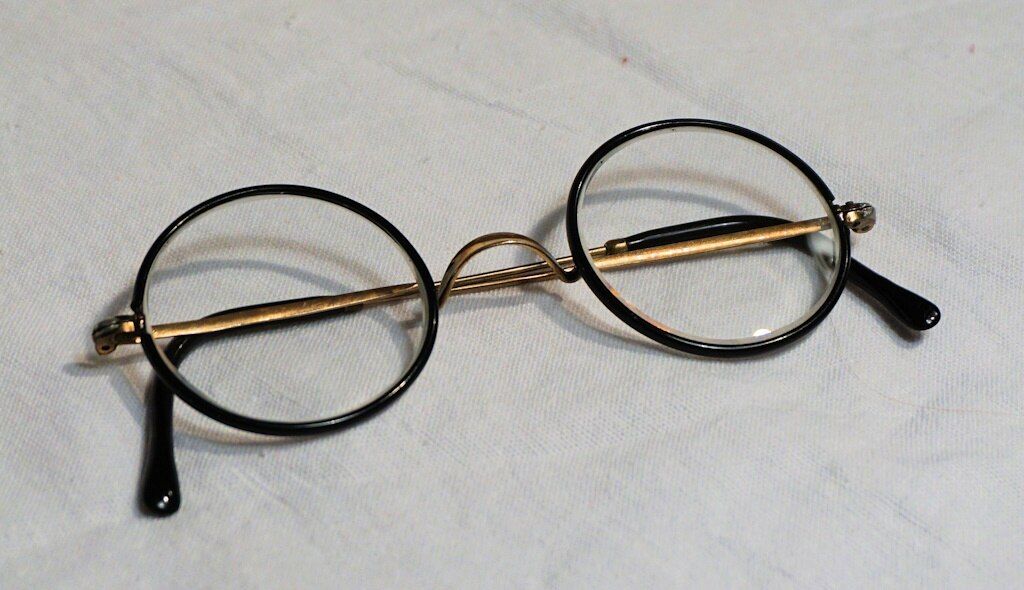
By the 20th Century, glasses were no longer just functional — they became fashion statements. Plastic lenses and frames made eyewear more affordable, colourful, and customisable. From the glamorous cat-eye frames of the 1950s, worn by famous glasses wearers like Marilyn Monroe, to the oversized styles of the 1980s, glasses became a powerful expression of style.
With advances in optometry, visiting an optometrist also became part of regular eyecare.
Progressive lenses, or varifocals, were first developed in the 1950s. Unlike bifocals, they removed the visible line between different viewing zones, offering a smooth, natural transition.
Sunglasses also took on a whole new identity. Once used by Chinese judges to hide their expressions, they evolved into a global fashion trend.
The development of contact lenses offered a discreet alternative to traditional spectacles. In recent years, blue light–blocking coatings have become popular for people who spend long hours on digital devices, helping to reduce eye strain and fatigue.
Today, eyewear is at the cutting edge of technology. Smart glasses such as Ray-Ban® Meta integrate cameras, music, and live-streaming features. Some modern frames even include built-in hearing aids — combining visual aids and hearing support in one sleek device. These innovations highlight the exciting future of eyewear design.
From Nero’s emerald to the Venetian craftsmen of the 13th Century, the story behind the invention of glasses is one of creativity, science, and constant innovation. Whether you wear prescription glasses, contact lenses, or trendy frames with blue light filters, every pair connects you to over 800 years of progress.
The future of eyewear promises even more exciting advancements — from sustainable materials to AI-powered lenses that automatically adjust to your surroundings. One thing is certain: our fascination with seeing the world more clearly — and our curiosity about who invented eyeglasses — will never fade.