







How can you tell which eye is dominant? A step-by-step guide
9 September 2026

Quick answer: Make a small triangle with your hands, centre a distant object inside it and then close one eye at a time — the eye that keeps the object framed is dominant. This is called the Miles test, and it takes about 30 seconds. Around 70% of people are right-eye dominant, but there's no wrong answer here — just useful self-knowledge for golf, outdoor sports, photography and prescription sunglasses fittings.
Line up a finger over a distant doorknob, keep both eyes open and then shut one eye at a time. Half the time nothing moves; the other half, the finger jumps sideways. That little jump is the dominant eye giving itself away — the one the brain trusts to aim.
All it takes is a distant object, both hands and about 30 seconds. Below: the full test, a couple of backup methods if the result is not clear-cut, and where knowing your dominant eye comes in handy.

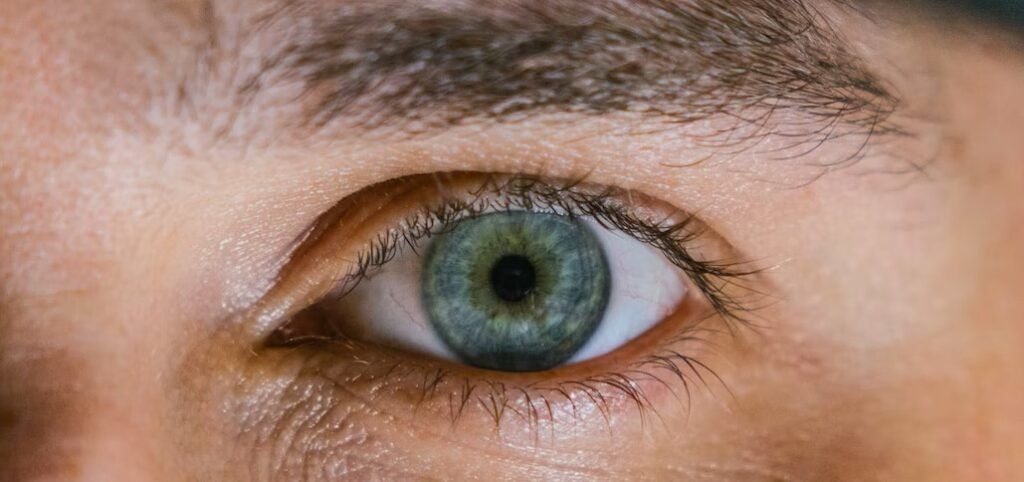
Ocular dominance is the brain's tendency to favour one eye over the other — a visual equivalent of being right- or left-handed. When you look at something, your brain treats one eye as the lead: it relies on that eye's input first and quietly turns down the volume on the other. Both eyes still work together to judge depth and distance, but the dominant eye gets the final say.
Why does the brain bother? Efficiency. Your two eyes see the world from slightly different angles, and that small gap is what lets you judge distance. Rather than weigh up both feeds equally, the brain picks a favourite and saves itself the effort.
There isn't just one kind of dominance, either. The Cleveland Clinic splits it into three types:
| Type of dominance | What it is | How it's checked |
|---|---|---|
| Motor (sighting) | The eye naturally used to aim — the one that lines up on a target | The home tests below |
| Sensory | The eye the brain favours when both send competing pictures | A clinic test with special lenses |
| Acuity | Simply the eye with sharper vision | A standard sight test |
Most of the time, “dominant eye” means the sighting one — the eye naturally used to aim. That's the one the tests below reveal. Around 30% of people are left-eye dominant, so a left result is perfectly normal.

If eye dominance has never crossed your mind before, here's how to find out. It's called the Miles test, named after psychologist Walter Miles, who first described it in 1929. All it needs is a distant object and both hands.
If the object stayed centred with only the right eye open, the right eye leads. If it held steady with only the left open, that's left-eye dominance.
Not convinced by the first result? Two more methods work on the same principle — lining up something near with something far.
Stretch one arm out, thumb up, and with both eyes open cover a distant object with it. Close one eye, then the other. The eye that keeps the thumb sitting right on the object is the dominant one — the other will make the thumb appear to hop sideways.
Cut a hole about 20mm wide (roughly the width of a thumb) in the centre of a piece of card, hold it at arm's length, and look at a distant object through the hole with both eyes open. Bring the card slowly towards the face while keeping the object in view — it will naturally drift back towards the dominant eye.
Don't worry if the test felt a bit fuzzy — dominance isn't always black and white. Sometimes the object sits halfway between the two eyes, and that's normal too. This is called mixed (or alternating) dominance: one eye leads for some tasks, the other takes over for the rest. According to the Cleveland Clinic, just under 7% of people don't land on a clear preference.
It's also worth knowing that the aiming eye isn't always the eye the brain favours when both are open. That deeper sensory preference can only be measured with special equipment at an optician, so a slightly wobbly kitchen-table result isn't something to read into. Run the test on a few different days — if the same eye keeps winning, that's the answer.

Anyone who spends weekends on a golf course, a shooting range or behind a camera has a dominant eye quietly running the show. It's the eye that judges the line in golf, cricket and clay shooting, which is why coaches fuss over how a player turns their head.
It matters even more for anyone who's cross-dominant — where the aiming eye and the steady hand sit on opposite sides. That's more common than it sounds, and it isn't neatly tied to handedness: being right-handed doesn't guarantee right-eye dominance. Take a right-handed clay shooter with a dominant left eye: on a fast target, they'll keep drifting off the mark. The fix is simple — keep both eyes open until the last second, then trust the leading eye for the shot.
The same logic applies to a camera. Line the viewfinder up with the dominant eye, and the framing matches the shot. It's worth mentioning at the opticians too — the dominant eye guides how monovision (one contact lens set for distance, the other for near) or multifocal lenses are fitted. Anyone playing sport or shooting in bright light should also consider prescription sunglasses to keep that leading eye sharp in the glare.
For most people, it's the right eye. For 30%, it's the left, and for a small few, it's a genuine toss-up. Run the Miles test, the thumb test or the hole-in-a-card test a couple of times across different days — whichever eye keeps winning is the answer. It's a neat piece of self-knowledge, handy on the range or behind a lens and worth a mention at the next eye test.
When it's time for a new pair, the eye that leads won't decide what suits — face shape, style and how the frames feel will. The easiest way to get that right is the free Home Trial: order a few pairs, wear them for a few days and then send back whatever doesn't fit. Browse glasses and sunglasses by shape once your favourite is clear, or book an eye test to get expert advice on the right fit.
Make a small triangle with both hands, centre a distant object inside it with both eyes open and then close one eye at a time. Whichever eye keeps the object framed is dominant. This is the Miles test, and it's the fastest way to check at home.
The Miles test, thumb test and hole-in-a-card test can all be done at home with no equipment beyond a small object across the room and both hands. Try more than one method and repeat on different days for a reliable result.
Line up a near object (a thumb, or the gap between your hands) with a distant object using both eyes, then close each eye in turn. The eye that keeps the two objects aligned when it stays open is the dominant one.
Repeat the test a few times across different days. If the object keeps drifting rather than clearly favouring one eye, this may be mixed (alternating) dominance, which affects just under 7% of people. An optician can confirm this with a proper sensory test.
The dominant eye is the one used to aim, whether that's lining up a golf shot, a camera viewfinder or a shotgun. Cross-dominant players — where the dominant eye and dominant hand are on opposite sides — often need to adjust their stance or keep both eyes open longer to compensate.